%20(1).png?width=200&height=80&name=Trillium%20Counselling%20Logo%20(999%20x%20398%20px)%20(1).png "Trillium Counselling Logo (999 x 398 px) (1)")
EMDR therapy is a structured, evidence-based psychotherapy that uses guided bilateral stimulation to help your brain reprocess distressing memories so they feel less intense. EMDR stands for Eye Movement Desensitization and Reprocessing, and the bilateral stimulation can take the form of guided eye movements, taps, or tones while you briefly recall a distressing memory. The leading theory is that this helps the brain reprocess the memory so it feels less vivid and emotionally intense over time, and EMDR is delivered in eight structured phases — best established for trauma and PTSD.
Last updated: July 2026 · Written by Christopher Hein, Co-Founder, Trillium Counselling
Moving your eyes back and forth to heal old wounds can sound a little strange the first time you hear it. If that's where you are — curious, maybe a bit skeptical — you're in the right place to find out what's actually happening here.
EMDR is one of the most studied trauma therapies in the world, recognized for treating post-traumatic stress by organizations including the World Health Organization and the American Psychological Association. It isn't hypnosis, and it isn't a gimmick — it's a structured approach to helping your brain do something it already knows how to do: process a painful experience so it stops feeling like it's happening now.
This guide walks through what EMDR is, how researchers believe it works, what it can help with, and what a session actually feels like. You can also learn more about EMDR therapy at Trillium.
What is EMDR therapy?
Eye Movement Desensitization and Reprocessing is a structured therapy developed by Francine Shapiro that uses guided eye movements — or taps or tones — while you briefly recall a distressing memory, helping the brain reprocess it. It follows a standardized eight-phase protocol.
The name is a mouthful, so it's worth slowing down on it. The "eye movement" part is what most people have heard about, but it's only one piece of the process. EMDR is a complete, step-by-step process — the EMDR International Association describes it as an eight-phase protocol, meaning the work is broken into clear stages that matter as much as the reprocessing itself. The eye movements (or the taps and tones) are just one tool used inside it. We'll walk through all eight phases below.
What does EMDR treat?
EMDR is best established as a treatment for post-traumatic stress disorder (PTSD) and trauma, and is recommended for PTSD by bodies including the World Health Organization and the American Psychological Association. Researchers are also studying it for other concerns, such as anxiety and depression.
The experiences behind trauma and PTSD vary widely — from a single accident or assault to repeated trauma, childhood trauma, sudden loss, or trauma experienced at work — and EMDR was designed with exactly this range in mind.
Beyond trauma, EMDR is being explored for a broader set of concerns:
- EMDR is most often used for: post-traumatic stress, single-incident trauma, and complex or repeated trauma.
- Researchers are also exploring EMDR for: anxiety, depression, panic, obsessive-compulsive symptoms, and addictions (effectiveness for these is still being studied).
If you're wondering whether your own experience "counts" as trauma — something that often holds people back from starting therapy — this is worth talking through with a therapist rather than deciding alone. You can read more about trauma therapy and how it overlaps with EMDR.
How does EMDR therapy work?
The exact mechanism isn't fully understood, but the leading explanation is that briefly recalling a distressing memory while your attention is partly occupied appears to make the memory less vivid and emotionally intense, so the brain can re-store it in a calmer, less distressing form — a process often linked to memory reconsolidation.
Most of the time, your brain works through a difficult experience on its own. The part that sounds the alarm, the part that files away memories, and the part that makes sense of emotions coordinate together so the experience gets stored as something that happened in the past.
The leading theory — as the EMDR International Association and the American Psychological Association describe it — is that under intense stress this coordination can be interrupted, so the memory stays "unprocessed." It keeps its original images, emotions, and body sensations, and comes flooding back when something reminds you of it.
Another way this is commonly described is that the memory gets "stuck" — the intense stress interrupted the normal process of storage. This is potentially why it can feel more raw and vivid, because the normal memory processing sequence was interrupted.
EMDR is thought to help the brain finish the processing it didn't get to complete. This reprocessing happens while your attention is gently divided — recalling the memory while following a back-and-forth movement or sound. This core piece of the EMDR process, side-to-side input, is called bilateral stimulation.
What is bilateral stimulation?
Bilateral stimulation is rhythmic, alternating left-right input. This is most commonly side-to-side eye movements or hand-held "pulsers" that give a gentle vibration from left to right hands (but it can also be gentle taps, or tones through headphones). Researchers believe pairing this back-and-forth stimulation with memory recall occupies the "working memory," which can eventually reduce the memory's vividness and emotional charge.
As mentioned, this stimulation can take a number of different forms. Visual stimulation uses side-to-side eye movements, often following the therapist's hand or a moving light bar. Tactile stimulation uses alternating taps, sometimes through small hand-held pulsers. Auditory stimulation uses tones that alternate between your left and right ears through headphones. The form matters less than the underlying process — useful flexibility, since taps or tones can replace eye movements when needed, including during online sessions.
So why does dividing your attention help? The leading explanation is the working-memory account: your working memory can only hold so much at once, and recalling a memory while tracking a back-and-forth task gives it less room to feel vivid. Researchers such as van den Hout and Engelhard, building on dual-task working-memory studies, and de Jongh and colleagues have proposed and tested this idea, and more recent reviews continue to examine it.
Ad de Jongh suggests that working with a memory this way, over repeated sets, gives the brain a chance to reprocess it — to re-store it in a form that feels less vivid and less emotionally charged when it comes to mind later. This idea is part of the working-memory theory of EMDR, and it's understood as a believed mechanism that unfolds gradually, not an immediate or guaranteed effect — it does not erase what happened or force you to relive it in detail.
Throughout the EMDR process, your therapist works at a pace that feels manageable for you and can adjust the type of bilateral stimulation along the way (for example, you may feel more comfortable with hand-held pulsers compared to lights). In the end, the goal is for the memory to become less intense in the moment, which seems to make it easier for the brain to store it in a calmer form.
It's worth being honest about the limits: eye movements specifically are debated, and this is a believed mechanism that unfolds gradually rather than an immediate or guaranteed effect. EMDR doesn't erase memories or force you to re-live them in detail — it's thought to change how a memory feels, not make it disappear completely.
Wondering whether EMDR is a fit for what you're dealing with? A free 20-minute matching consult with our care coordinator can help you figure out whether EMDR — or another approach — makes sense for your situation. No pressure, no obligation.
What does the research say about EMDR?
It helps to picture the evidence as a gradient, from settled to still-being-worked-out:
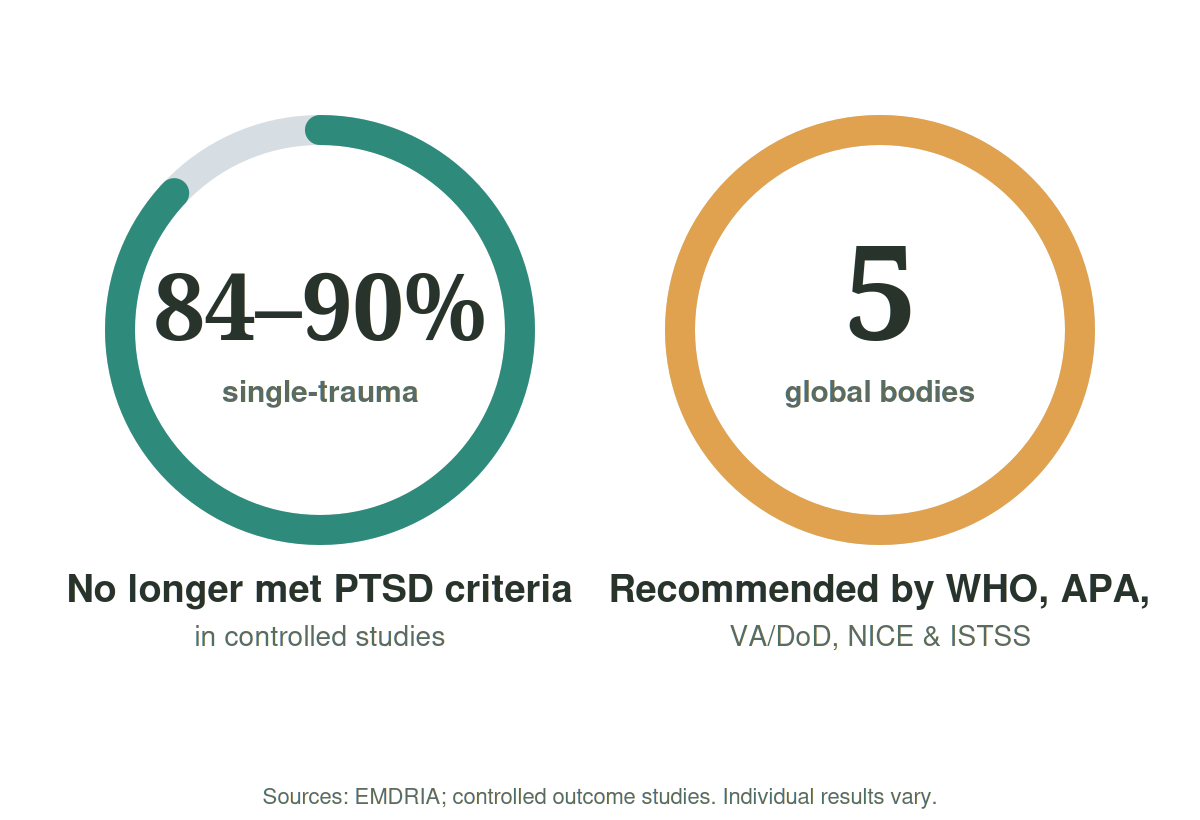
Strong and well-established: For PTSD and trauma, the outcome evidence is solid, and EMDR is recommended in trauma-care guidance from the World Health Organization and the American Psychological Association (current as of July 2026). This, and the underlying research, is the ground EMDR stands on most firmly.
Still an open question: The exact mechanism — why it works — is genuinely debated, which is why we describe it throughout as the leading theory rather than settled fact.
Emerging: For concerns beyond PTSD, such as anxiety and depression, the research is earlier and ongoing; reviews summarized by EMDRIA and published in journals such as Frontiers in Psychology describe these uses as preliminary and still being studied.
To make the "strong" tier concrete: in one early study, most participants no longer met the criteria for PTSD after about six EMDR sessions — though this was a single study of single-incident trauma, everyone's timeline differs, complex or repeated trauma generally takes longer, and this is an illustration of what's possible rather than a typical or promised outcome (Marcus, Marquis & Sakai, 1997, Psychotherapy).
How is EMDR different from CBT?
CBT and EMDR are both evidence-based, but they work differently. CBT focuses on identifying and changing unhelpful thoughts and behaviours, often with structured exercises and homework. EMDR focuses on helping the brain reprocess a distressing memory using brief recall paired with bilateral stimulation, usually without detailed retelling or homework.
Neither is "better" in the abstract — they're suited to different things, and a trained therapist will help you figure out which fits, or whether a blend makes sense. The American Psychological Association includes both EMDR and CBT-based approaches in its guidance for treating PTSD.
The 8 phases of EMDR therapy
EMDR follows eight standardized phases, moving from history-taking and preparation through reprocessing the memory and re-evaluating progress. The phases exist to keep the work safe and paced — you aren't asked to reprocess a memory until you have coping tools in place.
Phase 1 — History & treatment planning
In Phase 1, your therapist reviews your history, current concerns, and strengths, and identifies the specific memories ("targets") to work on. No reprocessing happens yet — this phase is entirely about understanding your story, gauging your readiness, and making a treatment plan together.
Phase 2 — Preparation
In Phase 2, your therapist explains how EMDR works and teaches grounding and calming techniques, such as a "safe place" exercise, so you can manage distress both between and during sessions. This is the safety-building phase, and it isn't rushed — you move on only when you're ready.
Phase 3 — Assessment of the target memory
In Phase 3, you and the therapist pinpoint a specific target memory, the negative belief attached to it, and a preferred positive belief. You also rate your current distress on a 0–10 scale, setting a clear baseline you can measure progress against as the work unfolds.
Phase 4 — Desensitization (the reprocessing)
In Phase 4, while you briefly hold the memory in mind, the therapist guides sets of bilateral stimulation — eye movements, taps, or tones. New thoughts and sensations tend to surface, and the sets continue until your distress rating comes down. This is the heart of EMDR.
Phase 5 — Installation
In Phase 5, the therapist helps strengthen the positive belief you chose, pairing it with the memory through further bilateral stimulation until the new belief feels true. A belief like "I'm not good enough" or "I'm in danger" may shift toward "I survived, and I'm safe now." The memory itself doesn't change — what changes is the meaning and emotional charge attached to it.
Phase 6 — Body scan
In Phase 6, you hold the target memory and the newly strengthened positive belief in mind while scanning your body for any lingering tension. You then work through any physical disturbance that's still there, because trauma is often held in the body as well as the mind.
Phase 7 — Closure
In Phase 7, the therapist helps you return to a calm, stable state at the end of each session, using the grounding techniques you learned in Phase 2. This happens whether or not the reprocessing of a particular memory is fully complete, so you always leave settled.
Phase 8 — Re-evaluation
In Phase 8, at the start of the next session, you review your progress to confirm the gains have held and decide what to focus on next. Reprocessing a single memory may take one session or several, depending on its complexity and how it connects to other experiences.
What does an EMDR session actually feel like?
In a typical EMDR session, you stay fully awake and in control. You briefly bring a memory to mind while following the therapist's hand, a light bar, or alternating taps and tones, then pause to notice what came up. You can stop at any point — it is not hypnosis. Sessions usually run 50 minutes.
EMDR can be emotional, and it's normal to feel tired or tender afterward — part of the work, not a sign something's wrong. It can be delivered in person or through online EMDR, depending on what suits you.
One reassurance that matters here: in Ontario, psychotherapy is a regulated health profession, and Trillium's therapists are registered with their colleges — the College of Registered Psychotherapists of Ontario (CRPO) or the Ontario College of Social Workers and Social Service Workers (OCSWSSW) — so they meet provincial standards for training, ethics, and ongoing competence.
Is EMDR right for you?
EMDR can help people carrying distressing or traumatic memories, but it isn't right for everyone, and suitability is assessed individually with a trained therapist before ever starting the process. A consultation is the best way to find out whether EMDR — or another approach — fits your situation.
EMDR might be worth exploring if:
- A distressing memory keeps intruding, or still feels vivid and raw long after the event.
- You feel "stuck" — circling the same reactions and not sure why.
- You're noticing trauma-related patterns like being easily startled, on edge, or avoiding reminders.
It's also honest to say EMDR isn't always the first step. For some people — during an acute crisis, before basic safety is stable, with significant dissociation, or before grounding skills are in place — a period of stabilization may come first. This isn't something to determine on your own from a webpage; a therapist will talk it through and find the right starting point with you. Trillium's guide on how to tell if you have trauma or PTSD is a helpful companion read.
Frequently asked questions
Why is EMDR done with eye movements — does the eye movement itself heal trauma?
Why is EMDR done with eye movements — does the eye movement itself heal trauma?
Not on its own. The eye movements are just one form of bilateral stimulation (taps or tones work too), and they're not magic. What matters is pairing brief memory recall with a dual-attention task — explained in the bilateral-stimulation section above — not the eye movement by itself.
What's actually happening in the brain during EMDR?
What's actually happening in the brain during EMDR?
The leading explanation is that recalling a memory while completing a dual-attention task "taxes" the brain, which makes the memory less vivid and emotionally charged, letting the brain re-store it in a calmer form (a process linked to memory reconsolidation). The exact mechanism is still being researched, so this is the leading theory rather than settled fact.
How strong is the evidence that EMDR works?
How strong is the evidence that EMDR works?
For PTSD and trauma, the outcome evidence is strong, and EMDR is recommended by organizations including the World Health Organization and the American Psychological Association. For conditions beyond PTSD — such as anxiety or depression — the evidence is still emerging, and researchers are continuing to study how effective it is on other issues.
Is EMDR different from regular talk therapy, and how?
Is EMDR different from regular talk therapy, and how?
Yes. Talk therapy works largely through discussing challenges and making meaning of experiences. EMDR instead pairs brief memory recall with bilateral stimulation to help the brain reprocess the memory, so you often don't need to describe the event in detail. The two are frequently combined for greater impact.
Why are there 8 phases — couldn't you just do the reprocessing?
Why are there 8 phases — couldn't you just do the reprocessing?
The structure exists for safety and durability. The early phases build a treatment plan and coping tools before any reprocessing begins, the middle phases do the reprocessing, and the final phases stabilize and re-check progress. Skipping the preparation phases is exactly what the protocol is designed to prevent.
Will I have to relive my trauma in detail during EMDR?
Will I have to relive my trauma in detail during EMDR?
Usually not in the way talk therapy might. EMDR asks you to briefly bring a memory to mind rather than narrate it in detail. The preparation phase gives you grounding tools first, you remain awake and in control throughout, and you can pause the process at any time.
How many EMDR sessions will I need, and why does it vary?
How many EMDR sessions will I need, and why does it vary?
It varies because it depends on the memory. A single distressing event may reprocess in a few sessions, while complex or repeated trauma generally takes longer. Your therapist can help you get a general sense of this after the history and preparation phases — there's no fixed number that fits everyone.
Is EMDR safe, and what makes it safe?
Is EMDR safe, and what makes it safe?
EMDR is widely used and considered safe when delivered by a trained therapist. Its safety comes largely from the protocol: coping tools are established before any reprocessing, you stay awake and in control, and each session ends with a closure phase. Strong emotions can surface, which your therapist helps you manage.
Is EMDR a form of hypnosis?
Is EMDR a form of hypnosis?
No. EMDR is not hypnosis and does not put you in a trance or altered state. You stay fully awake, aware, and in control throughout, you remember everything that happens, and you can pause or stop at any time. The bilateral stimulation simply supports focused attention while you reprocess a memory.
If trauma or distressing memories are weighing on you, EMDR may be one path forward — and a short conversation is the easiest way to explore whether it's a fit. No pressure and no judgment, just a chance to talk through what you're dealing with.
Ready to see if EMDR is right for you? Book a free 20-minute matching consult with our care coordinator to talk through what you're dealing with and find the right starting point.
Learn more about EMDR therapy at Trillium
Crisis Resources
If you or someone you know needs support right now, help is available:
- 988 Suicide Crisis Helpline (Canada-wide): call or text 9-8-8 — free, confidential, 24/7.
- Here 24/7 (Waterloo–Wellington crisis & mental health line): 1-844-437-3247.
- If someone is in immediate physical danger, call 911.
About the reviewer — Devon Jorge, MSW, RSW — Devon is a Registered Social Worker (MSW, RSW), an EMDR-trained therapist, and Clinical Director at Trillium Counselling. She reviews Trillium's educational articles to ensure clinical information is accurate, responsible, and aligned with current psychotherapy best practices.
About this article — This article is intended for general education about mental health and the therapy process. It is not a substitute for professional diagnosis, treatment, or individualized mental health advice. If you have concerns about your mental health, please speak with a qualified health professional or contact local crisis services in an emergency.