
Skip to content
BURNOUT THERAPY · KITCHENER-WATERLOO & ONLINE ACROSS ONTARIO

Therapy for Burnout

Recover your energy, make sense of what wore you down, , and return to work on steadier ground
Stressed Professionals Banner Image - 2

Burnout therapy is talk therapy that helps you recover from chronic work stress, understand what wore you down, and return to work in a way you can sustain. At Trillium Counselling, Registered Social Workers (RSWs) and Registered Psychotherapists (RPs) offer 50-minute sessions in Kitchener-Waterloo and online across Ontario, using approaches such as CBT, ACT, and mindfulness. You can start with a free 20-minute consultation.

Last updated: October 2026

What is burnout?

Burnout is a syndrome caused by chronic workplace stress that hasn't been successfully managed. The World Health Organization includes it in ICD-11 as an occupational phenomenon rather than a medical condition, and describes three dimensions (World Health Organization).

Exhaustion

Feeling depleted or drained of energy, even after a weekend off.

Mental distance

Feeling cynical, negative, or detached from your job and the people in it.

Reduced effectiveness

Feeling less capable at work, as if your effort no longer makes a difference.

It's also common. In 2025, 39% of Canadian employees said they often or always feel burned out, up from 35% in 2023 (Mental Health Research Canada). Because the WHO definition is tied to work, the term doesn't officially apply to other parts of life, but many people use it for the exhaustion that comes with caregiving or parenting, and our therapists help with those too.


What are the signs of burnout?

Burnout tends to creep in. You might notice it first in your body, then in how you feel about work, and eventually at home. Ongoing stress can show up physically, too, from headaches and muscle tension to poor sleep (American Psychological Association).

In your body

Tired all the time, getting sick more often, and sleep that doesn't leave you rested.

In your mind

Brain fog, forgetfulness, and trouble focusing on tasks that used to feel easy.

At work

Sunday-night dread, cynicism about your job, and a sense that nothing you do is enough.

At home

Less patience, pulling away from friends and family, and no energy for things you enjoy.

If several of these sound familiar and have lasted for weeks—or rest no longer seems to help—they're worth taking seriously. Our guide Are you burning out without realizing it? walks through the early signs people most often miss.


What causes burnout?

Burnout grows out of a mismatch between you and your work, especially around workload, control, reward, community, fairness, and values (Maslach and Leiter, World Psychiatry). These are the five patterns we see most often.

Burnout isn't a personal failing: it usually reflects a poor fit between you and your work.

Illustration of a woman stacking more books onto a coworker who is bent under a tall pile of paperwork

Workload

Too much to do in too little time, with no real chance to rest and recover.
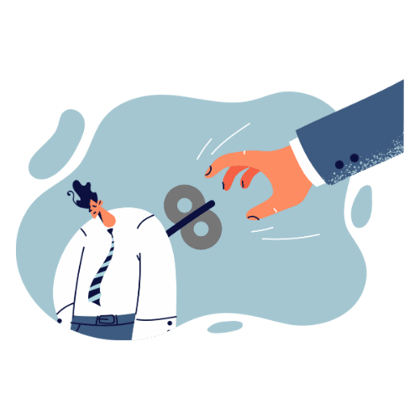
Illustration of a hand turning a wind-up key in a businessman's back, as if he were a wind-up toy

Control

Little say over what you work on, how you do it, or when it has to be done.

Illustration of office workers on laptops connected by circuit lines, with a manager standing over them

Culture

Low support, unresolved conflict, unfair treatment, or values that don't match yours.

Illustration of a smartphone overflowing with colourful message and notification bubbles

Technology

Email and messages that follow you home, so the workday never really ends.

Illustration of a person meditating, surrounded by a circle of icons representing the demands of daily life

Personality

Perfectionism and a hard time saying no can keep burnout going, especially under a heavy load.


What's the difference between burnout and stress?

Stress usually feels like too much: too much pressure, too many demands, and a body that won't switch off. Burnout feels more like not enough—not enough energy, motivation, or care left to give. It can develop when stress stays in its exhaustion stage for too long (StatPearls).

Compare Stress Burnout
Core feeling Over-engaged and urgent Disengaged and empty
Energy Wired, restless, always on Exhausted, even after rest
Emotions Anxious and on edge Flat, cynical, or hopeless
Focus Too much to do Nothing feels worth doing
Source Any part of life Chronic work stress
Where to start Stress therapy Burnout therapy (this page)

If the main source of pressure is outside work, or you mostly feel wired rather than empty, our stress therapy page may be the better place to start. Either way, our intake team can help you decide.


How can therapy help with burnout?

Man sitting by a bright window, resting his chin on his hand and thinking

Therapy helps you recover your energy, understand what led to burnout, and change what you can, both at work and in how you respond to it. A 2024 umbrella review found support for mindfulness, CBT, acceptance and commitment therapy, and rational emotive therapy for burnout, with CBT especially helpful for emotional exhaustion (Kern et al., 2024).

Lasting change often depends on what happens at work, too. Therapy that includes the work situation, such as a problem analysis and a return-to-work plan, helped people get back to work sooner than standard CBT (Demerouti et al., 2021). That's why our therapists look at both you and your job.

The situation: it's Sunday night, and you're already dreading Monday's inbox.

Running on empty

The tank keeps draining
Thought"If I just push harder, I'll finally catch up."
BodyHeavy limbs, a tight jaw, and another restless night.
ActionYou answer email until midnight and start Monday already drained.
By next SundayMore behind, more numb, and dreading Monday all over again.

With a recovery plan

Room to recover
Thought"Catching up isn't the goal. What can I let go of this week?"
BodyLaptop closed by 8 p.m. and a real wind-down, so your body gets to rest.
ActionYou raise your workload with your manager and book one thing just for you.
By next SundayStill tired, but less dread, and a plan you can actually keep.

Same job, same inbox. The difference is how you protect your time and energy, and working with a therapist can help you figure out how.


Which types of therapy help with burnout?

Your therapist will tailor the approach to you. These four come up most often in burnout therapy.

Cognitive behavioural therapy (CBT)

Untangle the thinking—like "I can never say no"—that keeps you overextended.

Acceptance and commitment therapy (ACT)

Reconnect with what matters to you and act on it, even when stress is high.

Mindfulness-based therapy

Notice your limits sooner and give your nervous system a real break.

Work-focused support

Plan your return, rethink workload and boundaries, and prepare for conversations with your manager.

Who provides therapy for burnout at Trillium Counselling?

Therapy for Burnout at Trillium Counselling is provided by Registered Social Workers (MSW, RSW) and Registered Psychotherapists (RP). Every therapist on our team can help with burnout and commonly help clients with work and life stressors of all sorts. All of them also offer secure online sessions, and most also see clients at our Waterloo office.

You're welcome to book directly with one of the therapists below, or book a free 20-minute matching consultation where we'll help match you with a therapist who feels like a good fit.


Meet our full team →

Show all 21 therapists


Right Therapist, Right Plan, Real Support

Evidence‑based therapy plus the right counselling match helps you move from coping to thriving—on a schedule that sticks. 

What does burnout recovery look like?

Recovery from burnout is usually gradual. Most people treated for stress-related exhaustion are back at work at follow-up (scoping review, 2022), but full recovery can take longer than expected. Seven years after treatment, almost half of the people in one Swedish study still reported fatigue, and 73% said they handled stress less well than before (Glise et al., 2020).

  1. Pause and protect

    Lower demands where you can, whether that means time off, a lighter load, or fewer evening emails.

  2. Understand it

    Map what wore you down, from workload and control to the habits that kept you going past empty.

  3. Rebuild energy

    Restore sleep, movement, and connection, and practise skills that calm your stress response.

  4. Plan your return

    Work out a gradual return, the accommodations you might ask for, and how to handle the first weeks.

  5. Protect progress

    Spot early warning signs, keep your boundaries, and know what to do if pressure builds again.

If you're off work or thinking about it, our guide to stress leave in Ontario explains how notes, EI, and returning to work fit together. For a closer look at timelines, read how to recover from burnout.

Is it burnout or depression?

Burnout and depression share symptoms such as exhaustion and low motivation, and they're closely linked, but research treats them as distinct (Koutsimani et al., 2019). Burnout is rooted in work, while depression tends to affect every part of life, including the things you used to enjoy away from work.

Only a doctor, nurse practitioner, psychiatrist, or psychologist can diagnose depression, but our therapists work with both. Read more in burnout vs depression, or visit our depression counselling page.


Burnout therapy in Kitchener-Waterloo and online across Ontario

Our office is at 55 Erb Street East, Suite 303, in uptown Waterloo, a short drive from Kitchener, Cambridge, and Guelph. Every therapist on our burnout team also offers secure video sessions anywhere in Ontario, so you can fit therapy in without adding another commute to your week.

In person in Waterloo

55 Erb Street East, Suite 303. Evening and Saturday morning sessions available.

Online anywhere in Ontario

Secure video from home, work, or a parked car. Read more about online counselling.


How much does burnout therapy cost, and is it covered by insurance or OHIP?

Burnout therapy costs $175 per 50-minute individual session at Trillium Counselling, online or in person. You'll find current fees, hours, and our cancellation policy on our hours and rates page.

Therapy with a Registered Social Worker or Registered Psychotherapist is not covered directly by OHIP, but many extended health plans include it, as long as your plan covers your therapist's designation (RSW or RP). We direct bill most major insurers where your plan allows, including Manulife, Sun Life, Canada Life, Green Shield, Blue Cross, NIHB, and TELUS eClaims. Many workplaces also offer an employee assistance program, so it's worth checking what yours includes.

Burnout therapy FAQs

What is burnout therapy?

What is burnout therapy?

Burnout therapy is talk therapy that helps you recover from chronic work stress. With a Registered Social Worker or Registered Psychotherapist, you'll look at what wore you down, rebuild your energy, and make changes you can sustain, at work and in how you respond to pressure. Common approaches include cognitive behavioural therapy (CBT), acceptance and commitment therapy (ACT), and mindfulness.

Does therapy help with burnout?

Does therapy help with burnout?

Research suggests it can. A 2024 umbrella review found support for mindfulness, CBT, acceptance and commitment therapy, and rational emotive therapy for burnout, with CBT especially helpful for emotional exhaustion (Kern et al., 2024). The same review notes that long-term results are less certain and that work conditions matter, so therapy usually looks at both you and your job.

What's the difference between burnout and stress?

What's the difference between burnout and stress?

Stress usually feels like too much: too much pressure and urgency, with a body that won't switch off. Burnout feels more like not enough: exhaustion, detachment, and a sense that your effort doesn't matter. Stress can come from any part of life, while burnout, as the World Health Organization defines it, comes from chronic workplace stress that hasn't been successfully managed (World Health Organization).

Is burnout a medical diagnosis?

Is burnout a medical diagnosis?

No. The World Health Organization includes burnout in ICD-11 as an occupational phenomenon, not a medical condition (World Health Organization). That's why a doctor may describe what you're experiencing in other terms. You don't need a diagnosis to start burnout therapy.

Can I keep working while I'm in burnout therapy?

Can I keep working while I'm in burnout therapy?

Yes, many people do. Therapy can help you lower the pressure where you can, set firmer boundaries, and decide whether a bigger change, such as reduced hours or time off, makes sense. If you're thinking about a leave, your doctor or nurse practitioner is the right person to assess whether you need one.

Can therapy help me return to work after burnout?

Can therapy help me return to work after burnout?

Yes. Your therapist can help you plan a gradual return, think through accommodations you might ask for, and prepare for the first few weeks back. Therapy that includes the work situation, such as a return-to-work plan, helped people get back to work sooner than standard CBT (Demerouti et al., 2021).

What happens in the first burnout therapy session?

What happens in the first burnout therapy session?

Your first session is mostly a conversation. Your therapist will ask how work and life have been, what you've noticed in your energy, mood, and sleep, and what you'd like to be different. Together, you'll start shaping a plan, often beginning with one small way to ease the pressure this week.

Can burnout happen outside of work, like caregiving or parenting?

Can burnout happen outside of work, like caregiving or parenting?

The World Health Organization's definition applies only to work, but many people feel the same exhaustion from caring for a family member or raising children. Our therapists work with that kind of exhaustion too, whatever you call it.

Do you offer burnout therapy online?

Do you offer burnout therapy online?

Yes. All of our burnout therapists offer secure video sessions anywhere in Ontario, and most also see clients in person at our Waterloo office. Many people find online sessions easier to fit around work.

How much does burnout therapy cost, and is it covered by insurance?

How much does burnout therapy cost, and is it covered by insurance?

Burnout therapy at Trillium Counselling costs $175 per 50-minute session. It isn't covered directly by OHIP, but many extended health plans cover therapy with a Registered Social Worker or Registered Psychotherapist. We direct bill Manulife, Sun Life, Canada Life, Green Shield, Blue Cross, NIHB, and TELUS eClaims where your plan allows.

Where can I find burnout therapy in Kitchener-Waterloo?

Where can I find burnout therapy in Kitchener-Waterloo?

Trillium Counselling offers burnout therapy in person at 55 Erb Street East, Suite 303, in uptown Waterloo, a short drive from Kitchener, Cambridge, and Guelph, and online anywhere in Ontario. Evening and Saturday morning sessions are available. You can start with a free 20-minute consultation, and our intake team will help match you with a therapist who feels like a good fit.

About the reviewer

Devon Jorge, MSW, RSW, is a Registered Social Worker and the Clinical Director at Trillium Counselling, and sees clients online and in person. This page was reviewed by Devon for accuracy. Last reviewed October 2026.

Not sure yet? Let’s talk it through.

If you’d like to ask questions or explore your options first, book a free 20-minute matching consult or give us a call (226-752-8857) . One of our team members will help you find the right therapist and next steps that feel comfortable for you.

If you need help right now

Call or text 9-8-8, Canada’s Suicide Crisis Helpline. It is free, confidential and open 24 hours a day, every day. In Waterloo Wellington, Here 24/7 answers around the clock at 1-844-437-3247. If someone is in immediate physical danger, call 9-1-1.

Trillium Counselling does not provide crisis services. For non-urgent support, book a free consultation or call 226-752-8857.