%20(1).png?width=200&height=80&name=Trillium%20Counselling%20Logo%20(999%20x%20398%20px)%20(1).png "Trillium Counselling Logo (999 x 398 px) (1)")
What Does Confidentiality Mean in Therapy? - Trillium Counselling
Confidentiality in therapy means your therapist cannot share what you tell them without your consent, except in specific situations set out by law. In Ontario, that duty comes from the Personal Health Information Protection Act, 2004 (PHIPA) and from the professional standards of the regulatory Colleges, including the OCSWSSW for social workers and the CRPO for registered psychotherapists. The limits — a serious risk of harm, a child who may need protection, a court order — are explained by your therapist during the informed-consent process before psychotherapy begins.
Walking into a therapist's office can be intimidating. There are lots of things to learn about how the process works and what therapy can do for you. You've probably heard that what you say in therapy is confidential, but what does that actually mean — and where does it stop? Let's walk through the basics, the exceptions, and the legal and ethical rules that sit underneath them.
What is client confidentiality?
By its nature, therapy tends to delve into private and sensitive information. It’s only natural to wonder who else will know what you share with your therapist, especially if you’ve had close relationships with people who didn’t respect your right to privacy.
Confidentiality is a legal and ethical obligation that your therapist has in order to preserve your privacy. Some of the small details about how that works may vary by office, but there are fundamental principles that guide these decisions. What it comes down to is that your therapist cannot reveal information about you and what you talk about, except in very specific situations.
Both Ontario Colleges make this a professional standard, not a courtesy. Registered Social Workers must "hold all client information in strict confidence" and may disclose it "only with client consent or when required or allowed by law" (OCSWSSW Code of Ethics and Standards of Practice, Principle V). Registered Psychotherapists "do not collect, use, or disclose information about a client without the informed consent of the client or their authorized representative, except as permitted or required by law" (CRPO Professional Practice Standard 3.1). Both Colleges also require therapists to explain the limits of confidentiality to clients at the start of therapy.
Confidentiality is also a legal concept that applies to every regulated health professional in Ontario, including Registered Social Workers and Registered Psychotherapists. The Personal Health Information Protection Act, 2004 (PHIPA) sets the rules for the privacy of personal health information in Ontario, and requires that it be kept confidential and secure — subject to the specific exceptions described later in this article.
This means that your therapist can’t chat about your life with anyone, show their notes about you, or detail what you share in any other way, except under specific circumstances (we’ll get back to those exceptions in a minute). It is important to note that as the client, you are free to share as much or as little as you want to with others about your sessions. Confidentiality in this case refers to the barriers in place for your therapist surrounding your personal health information.
There are basic confidentiality expectations every practice must follow but they can each also have an additional set of rules.
At Trillium, every therapist is a Registered Social Worker or a Registered Psychotherapist, so the rules described in this article come from their regulatory Colleges and from Ontario law rather than from any one practice's policy. If you are still working out what therapy involves and who you might work with, our psychotherapy page is the place to start.
In certain instances, you may wish to have your therapist share information about your sessions with someone else. If there is someone you would like your therapist to communicate with, such as a doctor, you will be asked to sign a formal release of information, giving them permission to do so.
In practice, the sensitive details you share with your therapist stay between you — unless one of the legal exceptions described below applies, or you ask for information to be shared.
Why does it matter?
It’s important for patients to feel free to discuss sensitive topics during therapy. Healing requires taking a clear-eyed look at your life. Knowing that your words won’t get back to the people in your life can help you open up about what you’ve experienced. Therapy is meant to be a shame-free zone.
Additionally, some people still experience social stigma around mental health problems. You shouldn’t have to worry that people will find out that you’re getting mental health support if you don’t want them to. Even the fact that you’re being seen in their office is something a mental health professional should not share.
Basically, confidentiality exists to protect you and give you a safe place to explore difficult experiences and emotions. You shouldn’t have to worry about other people’s opinions or judgments during such a vulnerable process.
Will my employer or insurance companies know I am in therapy?
In Canada, the confidentiality of your therapy sessions is generally protected by privacy laws, and your employer or insurance companies should not have direct access to the details of your therapy without your explicit consent.
If you use insurance benefits provided by your employer for therapy, the information shared with the insurance company is generally limited to essential details for processing claims, ensuring that specific therapeutic content remains confidential. It’s essential to review and discuss consent forms with your therapist at the outset to understand the boundaries of confidentiality and to address any concerns about the privacy of your therapy information.
Have questions about how therapy works before you start? You don't need to have anything figured out first. A free 20-minute consult with our intake team is a low-pressure way to ask what's on your mind and get matched with a Trillium therapist whose approach fits you.
Book a free matching consultConfidentiality in Mental Health Counselling
PHIPA guidelines for confidentiality include:
Personal health information
Personal health information is identifying information about a client. It can be in verbal, written or in electronic format, and does not necessarily include the client’s name. If a client can be recognized, the information is considered personal health information; it includes information in the client health record. Information that does not allow the client to be identified is not personal health information and is not subject to PHIPA.
Consent to the collection, use, and disclosure of personal health information
Counselling centers typically do not collect or use information about a client without the informed consent of the client or the client’s authorized representative, nor does the member disclose information about a client to anyone without the written informed consent of the client or the client’s authorized representative, except where disclosure is permitted or required by law.
Circle of care and “lock box”
The terms “circle of care” and “lock box” includes other health professionals who provide care to a client, other providers in a multidisciplinary setting, and other providers to whom the member has referred a client. PHIPA allows some health providers to assume in certain circumstances that a client has provided implied consent to disclose his/her personal health information to another individual within the circle of care or to a specific health care provider. Despite this generality, however, a client may indicate that s/he does not want certain information (or any information) shared, even within that circle. In this circumstance, the practitioner must not share the information. This is called placing information in a “lock box.”
Release of client information by Registered Psychotherapists
Because of the sensitivity of what is shared in psychotherapy, the College of Registered Psychotherapists of Ontario asks its registrants to take particular care before disclosing client information to other care providers. PHIPA allows health providers, in some circumstances, to rely on a client's implied consent to share information within the circle of care. Express consent is required under PHIPA whenever information goes to someone outside the health-care system, such as an insurance company, an employer's benefits plan, or a family member (CRPO, PHIPA guidance). Social workers follow the equivalent standard under the OCSWSSW's Principle V. Each Trillium therapist's regulator and registration number are listed on their profile, which you can reach from the team section of our psychotherapy page.
This standard is not intended to prevent members from sharing client information within a care team such as those found in a hospital or agency settings, nor in an emergency situation.
Professional discretion should be employed, and only relevant and necessary personal health information may be disclosed.
In obtaining informed consent from a client to disclose his/her information to any third party, the therapist must explain what information will be disclosed, to whom, the reasons for the disclosure, and the time-frame within which disclosure is to be made. The therapist should report back to the client following the disclosure.
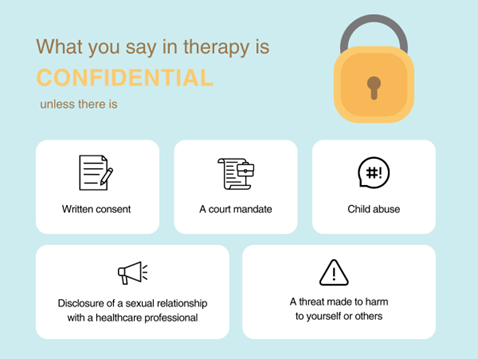
Exceptions to Confidentiality in Mental Health Therapy
Confidentiality is not absolute. Ontario law and the Colleges' standards set out specific situations in which a therapist is permitted — and in some cases required — to share information without a client's consent. The clearest examples are a serious risk of harm to you or to someone else, a child who may be in need of protection, and a court order. These limits apply to every regulated therapist in Ontario; they are not policies an individual practice chooses.
How each situation is handled is set out in the informed-consent agreement you review with your therapist before starting, and you can ask about it at any point. Here are the situations that most often limit confidentiality in Ontario.
1. With written consent
If you want your therapist to share information with someone else — a family doctor, a psychiatrist, a lawyer, an insurer — you will be asked to sign a release-of-information form that names who receives what, for what purpose, and for how long. You can narrow or withdraw that consent later. Consent is individual: in couples therapy, each partner's consent is needed before information about the couple's sessions is released outside of the couple since the file contains infomration on both clients.
2. Threats of harm
Ontario's privacy law allows a therapist to disclose personal health information when they believe, on reasonable grounds, that doing so is necessary to eliminate or reduce a significant risk of serious bodily harm to a person or group of people (PHIPA, s. 40(1)). This does not mean that having thoughts of suicide, or of hurting someone, leads to a report — those thoughts are common reasons people come to therapy, and talking about them openly is part of the work. The threshold is a serious risk that cannot be reduced within the session itself, such as a concrete plan and the means to act on it. In that situation a therapist may contact emergency services, a family member, or another health provider, and where it is safe to do so will generally try to involve you in that decision.
3. In the case of a sexual relationship with a healthcare professional
If a client discloses a sexual relationship with a regulated healthcare professional, we have a legal obligation to report it.
4. In cases of child abuse
Child abuse, including sexual and physical abuse and neglect, will be reported. Also, if a child is at risk in significant ways, including being exposed to domestic violence or coming in contact with known abusers, a call will be made to Family and Children Services.
5. By legal order
Occasionally, the court mandates a counsellor to disclose information, whether by testifying in court or submitting their files. This is a legal obligation that cannot be ignored.
6. In couples therapy
Although partners do not have access to each other’s information in individual therapy, couples therapy is different. Information is freely shared in couples therapy, and open communication is an important part of the process.
Trillium Counselling can give you a safe place to open up
If you've read this far, you may still be wondering what all of this would look like for you. The specifics are covered in the consent process before therapy begins, and you can ask your therapist anything about it — that conversation is part of the work, not a formality. Reaching out doesn't need to be a big step. A free 20-minute conversation with our intake team is a low-pressure way to ask what's on your mind and get matched with a therapist whose approach fits you, with no commitment.
Book a Free ConsultationCrisis Resources
If you or someone you know needs support right now, help is available:
- 988 Suicide Crisis Helpline (Canada-wide): call or text 9-8-8 — free, confidential, 24/7.
- Here 24/7 (Waterloo–Wellington crisis & mental health line): 1-844-437-3247.
- If someone is in immediate physical danger, call 911.
About the reviewer — Devon Jorge, MSW, RSW, Registered Social Worker, Psychotherapist — Devon is Clinical Director at Trillium Counselling and a Registered Social Worker authorized to perform the controlled act of psychotherapy. She reviews Trillium's educational articles to keep them accurate, responsible, and aligned with current Ontario legislation and College standards. Last reviewed September 2026.
About this article — This article is intended for general education about mental health and the therapy process. It is not a substitute for professional diagnosis, treatment, individualized mental health advice, or legal advice about your own situation. If you have concerns about your mental health, please speak with a qualified health professional or contact local crisis services in an emergency.
*The general contents of this website are provided solely for educational and informational purposes and are not meant to provide professional medical or psychiatric advice, counselling or therapeutic services. The information provided on our website in in regards to confidentiality in counselling and mental Health settings may vary based on your region and regulations / practices, and may have been updated since the posting of this article. This article is not designed to be a full depiction of confidentiality rules / regulations / practices. When starting therapy, it is always important review the terms of service agreement and to discuss any questions or concerns you may have regarding confidentiality with your therapist prior to beginning.*


.jpg)