What Is Psychotherapy and How Does It Work? A Plain-Language Guide for Ontario
Psychotherapy is a structured, evidence-based treatment in which a regulated therapist helps you change patterns of thinking, feeling and behaviour through a therapeutic relationship. Across hundreds of studies, its benefits are large on average and hold for most conditions, and the bond between you and your therapist is one of the clearest signs of how it turns out, a finding seen across 295 studies. In Ontario, psychotherapy is a controlled act that only members of six regulated health colleges may perform, including Registered Social Workers and Registered Psychotherapists.
Last updated: September 2026
If you are searching "what is psychotherapy," you are probably not writing a paper. More likely, you are wondering whether to book something, and you want to know what you would really be signing up for: what happens in the room, whether it works, how long it takes, and what all the different labels mean. This guide walks through those questions in plain language. The research and the Ontario rules are linked along the way, so you can check anything you read here.
What is psychotherapy?
Psychotherapy is treatment for emotional, psychological and behavioural difficulties that works through conversation and a planned relationship with a trained, regulated therapist. You may also hear it called talk therapy, or simply treatment based on "talking work" done with a therapist (CAMH). The talking has a direction, though. Together, you and your therapist agree on what you want to change, your therapist guides you with methods that have been tested for that kind of problem, and check in on whether they are working.
In Ontario, the word also has a legal meaning: the practice of psychotherapy is "the assessment and treatment of cognitive, emotional or behavioural disturbances by psychotherapeutic means, delivered through a therapeutic relationship based primarily on verbal or non-verbal communication" (Psychotherapy Act, 2007, s. 3).
That legal line is worth knowing, because it also tells you what psychotherapy is not. It isn't venting (though you will certainly be heard). It isn't advice (though you will leave with ideas). And it isn't coaching or a good talk with a friend, because the person across from you is a certified professional, follows a code of ethics and uses methods that have been studied. At Trillium, every therapist who provides psychotherapy is a Registered Social Worker or Registered Psychotherapist. You can meet the current team and see how sessions work on our psychotherapy page.
How does psychotherapy work?
Psychotherapy works through two things at once: a relationship that feels safe enough to be honest in, and specific methods for changing the patterns that keep a problem going. Each needs the other. A warm therapist with no plan tends to give you pleasant sessions and slow progress. A rigid protocol from someone you don't trust tends not to get followed.
The relationship between you and your therapist has been studied perhaps more than almost anything else in the field. You may hear it called the working alliance: how well you and your therapist agree on goals, agree on the tasks that will get you there, and importantly share a genuine interpersonal bond. Across 295 studies and more than 30,000 clients, that alliance was one of the most consistent signs of how therapy would turn out. The closer the bond, the better people tended to do, whatever kind of therapy they were in, wherever they lived and whatever they were working on (Flückiger et al., Psychotherapy, 2018). Put simply, when you feel understood and you both know what you're working toward, therapy tends to go better.
The method side is probably what you picture when you hear names like CBT or EMDR. Each approach has its own idea of why a problem keeps going, and a set of techniques for interrupting it: noticing and testing the thoughts that drive anxiety, processing a memory so it stops hijacking the present and practising a new response to conflict until it comes naturally. What the methods share is practice. Most of the change in psychotherapy happens between sessions, when you try something differently in your everyday life and bring back what happened.
One finding may surprise you. When well-structured therapies are compared head to head, they usually produce roughly similar results. How well therapy goes depends more on you, your therapist and the relationship between you than on the particular "brand" of therapy (American Psychological Association, 2012). That doesn't make the method irrelevant. Some approaches are better tested for specific problems, and the method gives the relationship something to do. But it does mean that finding a therapist you can work well with matters at least as much as finding the "right" acronym.
Does psychotherapy actually work?
Yes, for most people and most common problems, and the research behind that answer goes back decades. In 2012, after reviewing decades of trials, the American Psychological Association adopted a formal resolution stating that the general effects of psychotherapy "are widely accepted to be significant and large," that those effects are "quite constant across most diagnostic conditions," and that the benefits "tend to last longer and be less likely to require additional treatment courses than psychopharmacological treatments" (American Psychological Association, 2012).
Two more points from that review matter if you are deciding whether to start. First, the therapy you would get in an ordinary community setting works about as well as therapy in research studies, so the good results aren't just a product of the lab. Second, your gains often keep growing after therapy ends, because you leave with skills you keep using. Medication and psychotherapy aren't rivals here. You may benefit from both, as many people do, with medication prescribed and monitored by a physician or psychiatrist, and therapy working on the patterns and history medication can't reach.
It's only fair to give you the honest caveats, too. "Large on average" still means some people improve a great deal and some don't improve much. How much you gain can depend on how long the problem has lasted, how many things are going on at once, and how much support you have outside the room. Roughly one in five adults stops therapy before finishing, often without saying why (Swift & Greenberg, 2012). That's why your therapist should check progress with you rather than assuming, and why it's often worth speaking up early and telling your therapist directly if something isn't working for you. Therapists often operate with a large toolbox, and can always adjust to find what works best for you, but its best if they hear from you if the current approach isn't landing for you.
What are the main types of psychotherapy?
The main types of psychotherapy differ in what they focus on first: thoughts and behaviours, emotions and relationships, memories, or the stories you tell about yourself. Our therapists at Trillium are trained/experienced in more than one, so your therapist can blend them as your needs change. Below are the approaches you're most likely to see in Ontario, and the ones our therapists use most. Each has its own page if you want more detail.
- Cognitive behavioural therapy (CBT) — helps you spot the loops between thoughts, feelings and behaviours that keep anxiety, low mood or stress going, and gives you structured tools to interrupt them. Research shows it can help with a range of mental health and physical health conditions (Zandieh et al., CMAJ, 2024).
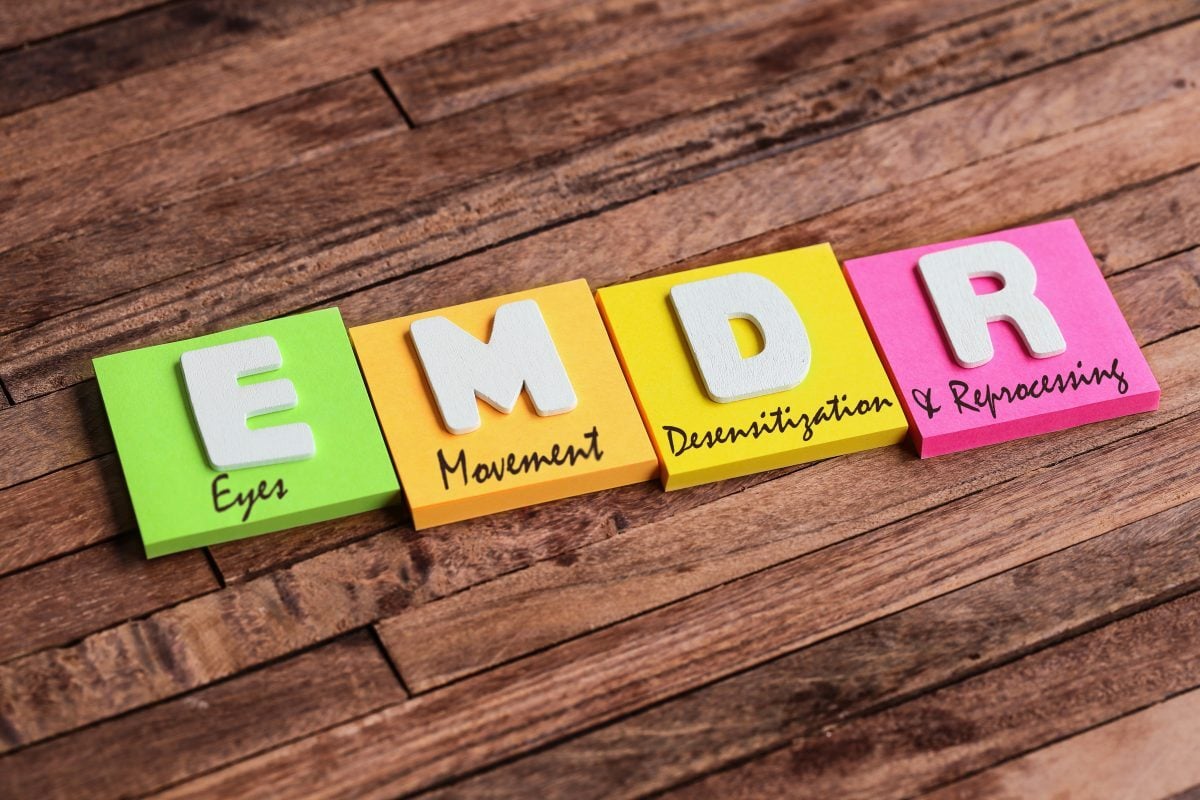
- Eye movement desensitization and reprocessing (EMDR) — a structured way to process distressing memories so they stop driving how you react today; used most for trauma and PTSD.
- Acceptance and commitment therapy (ACT) — builds psychological flexibility: making room for hard feelings while you take action on what matters to you.
- Dialectical behaviour therapy (DBT) skills — concrete skills for emotion regulation, distress tolerance and relationships, helpful when feelings escalate fast.
- Emotionally focused therapy (EFT) — works with attachment needs and the emotional cycles underneath conflict, whether you come on your own or as a couple.
- Psychodynamic therapy — explores how earlier relationships and unspoken patterns shape how you feel and choose now; usually longer and more exploratory.
- Solution-focused, narrative and mindfulness-based approaches — can be shorter or more reflective options that focus on your strengths, the meaning you make of your story, and steadier attention.
How do you choose a type of psychotherapy?
Start with the problem, not the acronym. Some concerns have a clear front-runner: often trauma-focused therapies for PTSD, CBT for panic and phobias, skills-based work for emotions that swing hard. For low mood, worry, relationship strain or "I'm not sure what's wrong, I just feel stuck," several approaches can work about equally well. Then the deciding factors are practical. Do you want homework and structure, or space to reflect? Do you want to work on the present, or understand the past? Which therapist can you imagine being honest with? Of course you don't need to decide the answers to this yourself, your therapists job is to ask the right questions, hear you and help guide you along the process.
A good intake conversation does this sorting for you. You describe what's going on and what you'd like to be different. The person you speak with suggests a therapist and an approach, and explains why. If you'd like a hand with that, our psychotherapy page explains how matching works at Trillium, and our guide to questions to ask a therapist covers what to raise in a first call.
Wondering which approach would suit you? In a free 20-minute matching consult, you can describe what has been going on and our intake team will suggest a Trillium therapist whose training fits, with no pressure to book.
Book a free matching consultPsychotherapy vs counselling: what the difference means in Ontario
In Ontario, psychotherapy is a legally regulated controlled act with protected titles, while counselling is a general term that is not regulated on its own. In everyday use, "counselling" usually means shorter-term, present-focused support around a specific situation, while "psychotherapy" tends to go deeper into longstanding patterns, emotions and history. The same therapist often provides both, so the label on a website tells you less than the letters after your provider's name.
Under Ontario's Psychotherapy Act, 2007, the titles "psychotherapist," "registered psychotherapist" and "registered mental health therapist" are restricted to members of the College of Registered Psychotherapists of Ontario, with exceptions that let members of other authorized colleges, including Registered Social Workers, use "psychotherapist" alongside their own professional title (Psychotherapy Act, 2007; OCSWSSW). The word "counsellor" doesn't appear in the Act at all. On its own, "counsellor" or "therapist" tells you nothing about whether someone is regulated, insured, bound by a code of ethics, or accountable to a College.
Ontario is one of two provinces, with Quebec, that regulate the profession of psychotherapy; Nova Scotia, New Brunswick and Prince Edward Island regulate "counselling therapy" instead, and several provinces regulate neither (Canadian Counselling and Psychotherapy Association). That's why advice written for another province, or another country, can mislead you about what a title means here.
Here is what this means in practice. If the person you are considering is a Registered Social Worker (RSW), Registered Psychotherapist (RP), psychologist, psychiatrist, nurse or occupational therapist authorized for psychotherapy, they can legally provide it, and you can check their registration on a public register. If the only credential offered is "counsellor," "coach" or a certificate, it's fair to ask which regulatory college they belong to. Our guide to the difference between a psychotherapist, psychologist and psychiatrist goes deeper on the regulated professions, and life coach vs therapist in Ontario covers the unregulated side.
How long does psychotherapy take to work, and how many sessions do people need?
This is a hard question to answer honestly, because no two people arrive in the same place. You bring your own history, your own pace and your own way of responding to change, and what you're working through matters too. Someone coming out of a recent setback may feel different within weeks, while someone carrying patterns that go back to childhood is often on a longer timeline. That's why no single number can tell you how long your therapy will take, and no therapist can promise one.
If you're looking for a general idea, recent research suggests that structured psychotherapy often runs 12 to 16 bi-weekly sessions, and that on average it takes 15 to 20 sessions for about half of people to recover, going by how they rate their own symptoms (American Psychological Association, Division 12). You may likely notice real change well before that. Some people and their therapists choose 20 to 30 sessions over months to build on their gains, and if you're dealing with several difficulties at once, or long-standing personality patterns, 12 to 18 months may be a better fit. We see a wide range of therapy length at Trillium.
Those are averages, and they hide a wide range. If your concern is recent and has a clear trigger, it usually takes fewer sessions. A pattern that has been in place since childhood usually takes longer, not because anything is wrong with you, but because there's more to work with. Short-term therapy can run up to about 16 sessions, while more complicated concerns may take about 20 (CAMH).
What you do have a say in is the pace. How often you meet depends on what you're working on, and you and your therapist can space sessions out as things improve. A good sign is a therapist who checks in on progress with you every few sessions instead of assuming it's working.
Does online psychotherapy work as well as in person?
For most common concerns, yes. In-person and therapist-guided online cognitive behavioural therapy showed "little to no difference" in how well they worked, across a range of mental health and physical health conditions, in a 2024 Canadian review of 54 studies with 5,463 people (Zandieh et al., CMAJ, 2024). The review concluded that working online can work better only in that it allows evidence-based care easier for you to reach.
The practical differences are real, but personal: whether you have a private space at home, whether a commute would stop you from going, whether you focus better on a screen or in a room. You might start in person and move online once the relationship feels established. Or, if you live hours from any office, you might work entirely by video. Both count as psychotherapy in Ontario, and the same regulatory rules apply. Our online counselling page explains how video sessions work and what you need.
How do you know psychotherapy is working?
Psychotherapy is working when the goals you set at the start are moving, even slowly, and when you can be honest with your therapist about what is not moving. In practice, change is rarely a straight line. Early on, it often looks like noticing a pattern while it's happening rather than afterward. Later, it looks like doing something different in the moment. Some weeks feel worse before they feel better, especially when you're talking about things you may have avoided for a long time.
After six to eight sessions, three questions make a fair check. Do you and your therapist both know what you are working toward? Have you tried anything differently outside the room? Do you leave sessions feeling understood, even when they were hard? If the answer to any of these is no, say so. When a strain between you and your therapist gets named and repaired, therapy tends to go better, and a therapist trained in Ontario expects that conversation. Your therapist is a working professional and getting feedback can be important to ensure you are meeting your goals. If you'd like a closer look at what a good fit feels like in the early sessions, our guide to the signs your therapist is a good fit walks through it.
If nothing changes after you raise it, our guide on when it might be time to change therapists walks through the decision.
Who is psychotherapy for, and when is it not enough?
Psychotherapy is for anyone whose thoughts, feelings or reactions are getting in the way of the life they want, whether or not they have a diagnosis. You might come because anxiety won't switch off, because you're snapping at people you love, because a loss or a change has knocked you sideways, or because you've carried something quietly for years and want to set it down. You don't need to be in crisis, and you don't need a referral. If you're unsure whether what you're dealing with "counts," our article on how to know if you need therapy may help.
Sometimes psychotherapy on its own isn't enough. If you're having dangerous thoughts, can't keep yourself safe, or have symptoms that make daily functioning impossible, please get same-day help from a crisis line, an emergency department or your physician. Therapy becomes part of the plan afterward. A formal diagnosis, when one is needed, comes from a physician, psychiatrist, nurse practitioner or psychologist. Your therapist can work with the pattern you are feeling and experiencing, and can help you decide when to involve your doctor.
If you've read this far, you probably already have a sense of what you're looking for. Reaching out doesn't have to be a big step. A free 20-minute conversation with our intake team is a low-pressure way to talk through what's been going on and get matched with a therapist whose approach fits you, with no commitment.
Book a Free ConsultationLearn more about psychotherapy at Trillium
Frequently asked questions
+Is psychotherapy the same as talk therapy?
Is psychotherapy the same as talk therapy?
Yes, in everyday use. "Talk therapy" is an informal name for psychotherapy, because the work happens mainly through conversation. The difference is that psychotherapy has a legal meaning in Ontario: it is a controlled act that only members of authorized regulatory colleges may perform. It also follows tested methods toward goals you agree on, rather than being open-ended talking.
+Is one type of psychotherapy better than another?
Is one type of psychotherapy better than another?
Not in general. When well-structured psychotherapies are compared directly, they usually produce roughly similar results. You, your therapist and the quality of your working relationship make more of the difference than the specific approach does. Some problems do have better-tested options, such as trauma-focused therapies for PTSD, so the method still matters for particular concerns.
+What does "evidence-based" mean in psychotherapy?
What does "evidence-based" mean in psychotherapy?
An evidence-based psychotherapy is one that has been tested in careful research, usually by comparing people who get the therapy with people who don't, and shown to help with a particular problem. It also means your therapist adapts that approach to you and tracks whether it is working, rather than applying a script. Cognitive behavioural therapy, EMDR, acceptance and commitment therapy and emotionally focused therapy are all examples with substantial research behind them.
+Is "counsellor" a protected title in Ontario?
Is "counsellor" a protected title in Ontario?
No. Ontario's Psychotherapy Act, 2007 restricts the titles "psychotherapist," "registered psychotherapist" and "registered mental health therapist," but it does not restrict "counsellor" or "therapist." Anyone can use those words, whatever their training. To confirm someone is regulated, look for a designation such as RSW or RP and check the public register of their regulatory College.
+Why does the relationship with your therapist matter so much?
Why does the relationship with your therapist matter so much?
Because it is one of the most reliable signs of how therapy will turn out. Across 295 studies, the stronger the bond between people and their therapists, and the more they agreed on goals and tasks, the better therapy tended to go, whatever the therapy or the problem. When you trust your therapist, it becomes possible to be honest about what is not working, and that honesty is what lets the method be adjusted to you.
Crisis Resources
If you or someone you know needs support right now, help is available:
- 988 Suicide Crisis Helpline (Canada-wide): call or text 9-8-8 — free, confidential, 24/7.
- Here 24/7 (Waterloo–Wellington crisis & mental health line): 1-844-437-3247.
- If someone is in immediate physical danger, call 911.
About the reviewer — Devon Jorge, MSW, RSW, Registered Social Worker, Psychotherapist — Devon is Clinical Director at Trillium Counselling and a Registered Social Worker authorized to perform the controlled act of psychotherapy. She reviews Trillium’s educational articles to help keep them accurate and responsible. Last reviewed September 2026.
About this article — This article is intended for general education about mental health and the therapy process. It is not a substitute for professional diagnosis, treatment, or individualized mental health advice. If you have concerns about your mental health, please speak with a qualified health professional or contact local crisis services in an emergency.